Can You Build a Basement in Arizona?
Yes, and people do it every year in the Valley. It is less common here because Arizona footings do not need to go deep, so every foot of excavation is an added cost rather than a byproduct of the foundation.
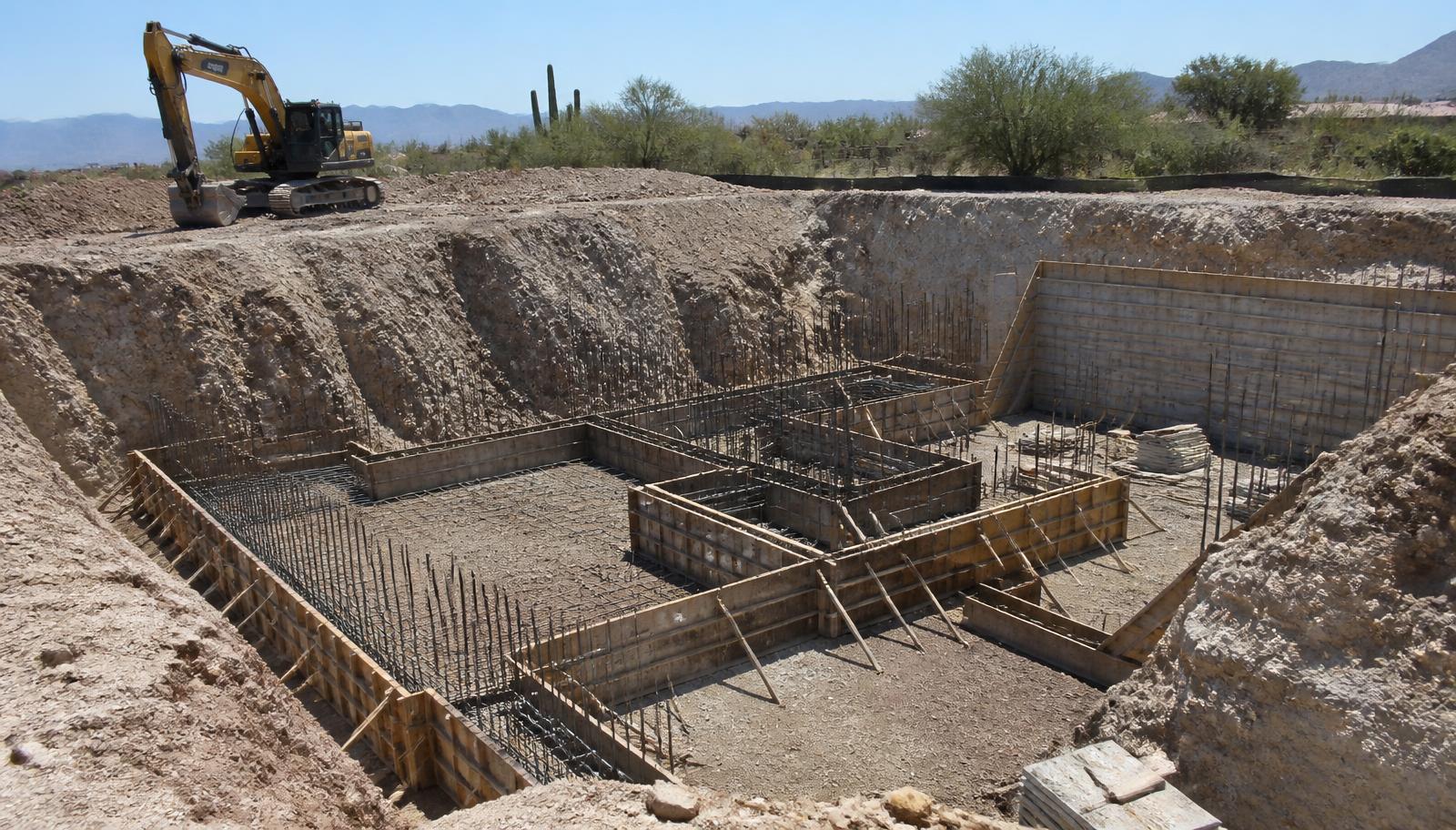
Short answer: yes. Basements get built across the Phoenix metro every year, and there is nothing about Arizona soil or code that prohibits them. The longer answer is about cost, and about why you see so few of them.
Why basements are rare here
In Minnesota or Ohio, the foundation has to reach below the frost line anyway. Once you are already digging four feet down, going the rest of the way to a full basement is comparatively cheap, which is why nearly every home in a cold climate has one.
Arizona has almost no frost depth requirement. A slab-on-grade foundation sits shallow, and that is all the structure needs. So a basement here is a pure add. You are paying for excavation, hauling spoil off the lot, shoring, engineered foundation walls, waterproofing, drainage, egress, and running mechanical and plumbing to a level that would not otherwise exist. None of it is subsidized by a requirement you already had.
What makes an Arizona lot harder
Caliche. This is the big one. Caliche is a naturally cemented layer of soil and calcium carbonate, and depending on depth and thickness it ranges from an annoyance to something that needs a hoe ram or specialized equipment to break. You do not know what you have until you dig or test. Two lots on the same street can differ.
Expansive and collapsible soils. Parts of the Valley have soils that move with moisture. That changes the engineering for below-grade walls and drainage and adds cost.
Water table. It is deep across most of the metro, which is in your favor, but it varies, especially near old agricultural land and washes.
Lot access. Excavation means equipment, and equipment means access. A tight infill lot in Arcadia with mature trees and neighbors twelve feet away is a different job than an open acre in Rio Verde.
Before pricing a basement we get a geotechnical report. Skipping it means the excavation number is a guess, and it is the largest single variable in the project.
What it costs
Expect a finished basement to carry a meaningful premium per square foot over the same space built at grade. The reason is that a basement is not just a room, it is excavation plus a structural foundation system plus waterproofing plus a drainage plan plus egress plus mechanical routing plus finish work.
Caliche, poor soils, or restricted access push that up. When homeowners ask us about a basement, we price it against the same square footage as an addition or a casita so the comparison is honest. Sometimes the basement wins. Often it does not, unless there is a reason it has to go underground.
When a basement makes sense
- Your lot limits you. If setbacks, lot coverage, or the buildable envelope cap your footprint, down is the only direction left. This comes up in Paradise Valley frequently, where coverage limits and hillside rules restrict what you can build above grade.
- Height restrictions. Same idea. If you cannot add a second story because of a height limit or a view corridor, a basement gets you square footage that does not count against height.
- Thermal performance. Below-grade space stays significantly cooler in an Arizona summer with much less mechanical effort. For a media room, wine storage, or a gym, that is a real benefit rather than a talking point.
- You want the space it uniquely provides. Wine cellars, safe rooms, sound-isolated theaters, and storage that does not eat into your living area.
When it does not
If you just want more square footage and you have room on the lot, an addition or a casita almost always costs less per foot and takes less time. A casita also gives you rental flexibility and separate access, which a basement does not.
Permits and egress
A basement is structural, so it requires engineered plans and a permit, always. This is one of the worst projects to attempt without one, because virtually none of it can be inspected later without demolition. If you want to know how that plays out, read what happens if you do work without a permit in Arizona.
Two code items to plan for early. Any basement with a sleeping room needs code-compliant emergency escape and rescue openings, which in practice means an egress window and a properly sized window well with drainage. And ceiling height matters. Once you account for the structure above and the mechanical running below it, the excavation depth needs to be planned for the finished height you actually want, not the minimum.
Retrofitting a basement under an existing house
People ask. It is possible and it is expensive. You are underpinning an existing foundation while the house stands on it, which is specialty work with real risk. On the vast majority of Valley homes it does not pencil against simply building out or up. We will tell you that before you spend money on a design.
Talk it through
If a basement is on your mind, the useful first step is a conversation about what you are trying to gain, then a look at your lot. We do that in pre-construction, before anyone commits to a direction. Call (480) 226-2978.
Frequently asked questions
- Can you build a basement in Arizona?
- Yes. Basements are built across the Phoenix metro every year. They are less common than in colder states because Arizona footings do not need to go deep for frost protection, so a basement is an added cost rather than a byproduct of the foundation. Soil conditions, caliche, and the water table drive how hard it gets on a specific lot.
- Why are basements rare in Arizona?
- In cold climates the foundation already has to reach below the frost line, so the extra depth for a basement is cheap. Arizona has almost no frost depth requirement, so every foot of excavation is a cost with no structural payback. Add caliche, which is a cemented soil layer that can need heavy equipment or breaking, and the math often favors building out or up instead.
- How much does a basement add to a build in Arizona?
- Treat a finished basement as a meaningful premium per square foot over slab-on-grade living space once excavation, shoring, waterproofing, egress, and mechanical routing are included. Caliche, a high water table, or a tight lot with limited equipment access push it higher. We price it against the same square footage added at grade so you can compare honestly.
- Do basements need egress windows in Arizona?
- Any basement with a sleeping room needs code-compliant emergency escape and rescue openings, which in practice means an egress window and a window well sized and guarded per code. That well and its drainage are part of the cost, not an afterthought.
- Is a basement worth it in Phoenix?
- It can be when the lot limits your footprint, when height or hillside rules cap what you can build above grade, or when you want the thermal benefit of below-grade space in summer. If you simply want more square footage on an open lot, an addition or a casita usually costs less per foot.
- Do you need a permit to add a basement?
- Always. It is structural, it requires engineered plans, and it involves excavation, shoring, waterproofing, egress, and mechanical work. It is one of the least advisable projects to attempt without a permit, because almost none of it can be inspected later without demolition.
Still Have Questions?
We're builders, but we're educators first.
If you're planning a project and need guidance, we'd be happy to talk through your ideas and help you understand your options.